


Product Catalog
- NOK SKF CFW SJ WYS DZ Parker Trelleborg
- Excavator fittings
- rock drill
- Broken hammer
- Chassis parts
- Maintenance parts
- GEAR PUMP SEAL KIT
- FLOATING SEALS
- BOX O-RING SEAL
- Other accessories BUSHI
- Belt tensioner pulley control stick
- PU shock absorber fan blade
- Bearing تحمل 베어링 mang แบริ่ง Несущий
- Shipping Records
- Electrical components đèn مصابيح โคมไฟ Throttle motor Throttle motor
- fan blade شفرة المروحة COMPRESSOR компрессор الضواغط
- Hydraulic components CENTER JOING KIT
- TOOL small machine
+8618819168678
No.3, Row E, Zone B, East Zhuji Construction Machinery Street, Zhongshan Avenue, Tianhe District, Guangzhou China
Operation Manual
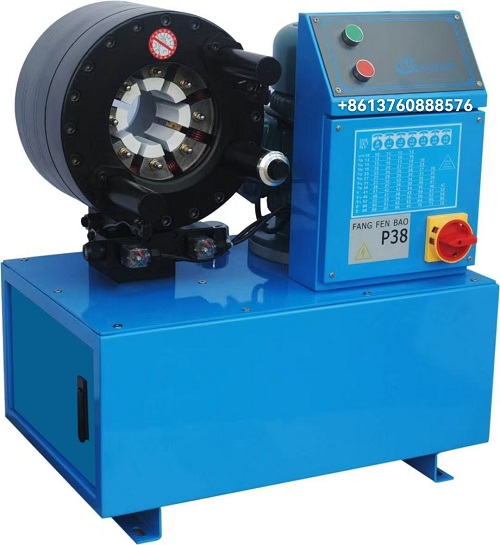
Operation Manual for Pipe Crimping Machine
Scope of application:
This crimping machine is a specialized equipment that deforms metal fittings under pressure, enabling them to be smoothly and precisely crimped onto rubber hoses, such as in hydraulic applications
Special equipment for machinery, injection molding machines, excavators, loaders, cranes, and automotive air conditioning hoses, which can smoothly and precisely crimp onto rubber hoses, such as (liquid
(Hydraulic machinery, injection molding machines, excavators, loaders, cranes, and automotive air conditioning hoses) are essential equipment for hydraulic machinery factories and excavator maintenance points. This machine has been in use since
With a failure rate of less than 1% within the year after being launched into the market, this is a stable, easy-to-use, and economical pipe crimping machine
1. Working principle
Driven by the motor, the oil pump outputs hydraulic oil, which pushes the plunger in the crimping cylinder forward, causing the plunger and the two inner conical sleeves on the front cylinder cover to push
The mold base with a symmetrical conical surface undergoes radial contraction, achieving the crimping of the module onto the hose. When the contraction reaches the set value on the scale, the crimping automatically stops, and the electricity
After the magnetic reversing valve reverses direction, the hydraulic oil enters two mold-opening cylinders, pushing the clamping plunger to move in the opposite direction. The mold base, under the action of the spring, drives the mold to return to its original position.
